
Thank you for Subscribing to Insurance Business Review Weekly Brief

Syensqo
Nicholas Contes, North America Insurance Manager
The Human Infrastructure Behind Effective Risk Strategy
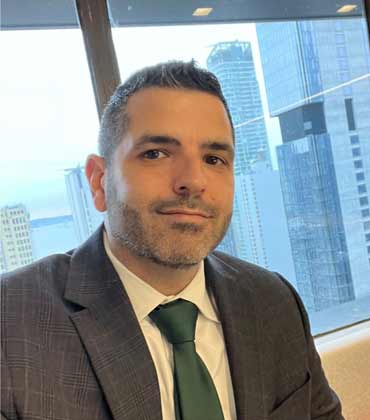
Nicholas Contes
Most professionals are, in many ways, products of their upbringing. In my case, my professional upbringing began as a licensed property and casualty insurance broker, where I was trained to live on the phone, answering calls, solving problems and delivering solutions in real time. Years later, at Henry Schein, Inc., I found myself constantly leveraging new technologies to advance risk management objectives. Taken together, these two experiences, human communication and disciplined use of technology, have shaped my core philosophy: effective risk management is built on relationships, powered by communication and scaled through technology.
When I began as a broker at Marsh & McLennan on Long Island in 2003, personal lines insurance was fundamentally a phone-driven business. My job was simple in theory but complex in execution: answer the phone, understand the problem and provide an insurance solution. I was trained early on that “the client can hear your smile through the phone.” It may sound anecdotal, but it is profoundly true. A smile changes your tone, conveys confidence and builds trust. Interestingly, smiling also makes you feel more positive and solution-oriented yourself.
What does this have to do with risk management? Everything. At its core, risk management is about solving problems and ultimately preventing them from occurring in the first place.
Being outward-facing within a risk management department is critical to success. Loss prevention does not take place behind a keyboard. It requires learning about the organization and its people. This is especially true when joining a new organization, as I did in December 2024 at Syensqo. If you are new, you cannot assume you understand how things work. You must ask questions, and sometimes questions that make you appear uninformed. I fully intend to ask many “stupid” questions. In reality, they are not stupid at all; they are necessary to understand the nuances of HR, payroll, reporting lines, operational processes and decision-making structures. One year into my role, I still have much to learn.
Understanding how an organization truly functions is essential to managing its risks. Is it hierarchical, flowing from top to bottom? Or is it collaborative and consensus-driven? Who are the informal influencers? Among twenty facility managers, there may be one who is particularly motivated to partner with risk management on loss prevention initiatives. You only discover that person by picking up the phone. Especially in a remote environment, being outgoing is even more critical. I am on video constantly because visibility and accessibility drive impact. A ten-minute phone call often resolves what a dozen emails cannot. So much gets lost in translation over email, whereas conversation builds clarity and rapport.
The communication “muscle” developed through years on the phone is also essential for influencing upward. Convincing a skeptical homeowner in a flood zone to purchase flood insurance is not so different from persuading a reluctant executive committee member to authorize higher cyber insurance limits. Both require listening, understanding underlying concerns, reframing risk in practical terms and aligning the solution with what matters to the decision-maker. All of this begins with conversation.
Being outward-facing within a risk management department is critical to success. Loss prevention does not take place behind a keyboard. It requires learning about the organization and its people.
A complex workers’ compensation claim is a perfect example of why communication is foundational to risk management. In such a claim, multiple stakeholders are involved: the injured employee, company management, operations leaders, HR, payroll, insurance adjusters, treating physicians and sometimes legal counsel. Each has distinct objectives and pressures. The injured worker wants timely treatment and reassurance. Management wants the employee to recover and return to work. The adjuster must manage costs and ensure compliance. If communication breaks down among these parties, the claim can quickly escalate in cost, duration and frustration. Speaking directly to each stakeholder allows a risk manager to understand the full dynamic.
Phone calls build relationships and accelerate resolution. Calling the employee injured in a rental car accident, guiding a facility manager through a property claim or helping an operations leader secure ergonomic evaluations for loss prevention—these actions build credibility. If you consistently help people solve small problems, the organization will trust you with larger ones.
Communication is one leg of effective risk management. The other is technology.
Most risk management departments operate with lean teams, and Syensqo is no exception. This reality makes the effective use of technology essential. Over the past two decades, I have witnessed the evolution of risk management information systems (RMIS) from relatively basic, early-generation websites to highly sophisticated, data-driven platforms capable of delivering meaningful analytics and strategic insight. Today’s insurance systems are powerful tools that can significantly enhance decision-making and operational efficiency.
However, the value of these systems should not be confined to insurance professionals alone. Broadening access and providing thoughtful training across the organization amplifies their impact. Investing time in training facility managers to use property insurance carrier tools yields measurable dividends. Similarly, equipping HR managers to navigate workers’ compensation claims systems improves oversight, responsiveness and outcomes. Transitioning processes such as property values collection into a centralized RMIS platform or shared digital environment enables multiple stakeholders to contribute simultaneously, increasing transparency and collaboration and making better informed-decisions.
When organizations take the time to train stakeholders across functions to use these systems effectively, the quality and reliability of data improves significantly. In turn, risk management teams can shift their focus from manual data gathering to higher-value activities, such as optimizing insurance program structure, evaluating risk transfer financing strategies and driving broader operational improvements.
Ultimately, my approach to managing insurance strategy across North America has been shaped by two constants: talk to people and use technology intelligently. Ask stakeholders what keeps them up at night. Understand their pressures and try to make their jobs easier.
My advice to professionals aspiring to leadership roles in corporate insurance and risk management is straightforward: become someone the organization relies on to solve problems. Return calls when you say you will. Be visible. Be helpful. If my colleagues consistently say, “Call Nick, he’ll take care of it,” I’ve built something far more valuable than a process or a report. I’ve built trust.
When trust and technology work together, risk management moves from a reactive function to a strategic partner. And that is where it delivers its greatest value.
The articles from these contributors are based on their personal expertise and viewpoints, and do not necessarily reflect the opinions of their employers or affiliated organizations.
