
Thank you for Subscribing to Insurance Business Review Weekly Brief


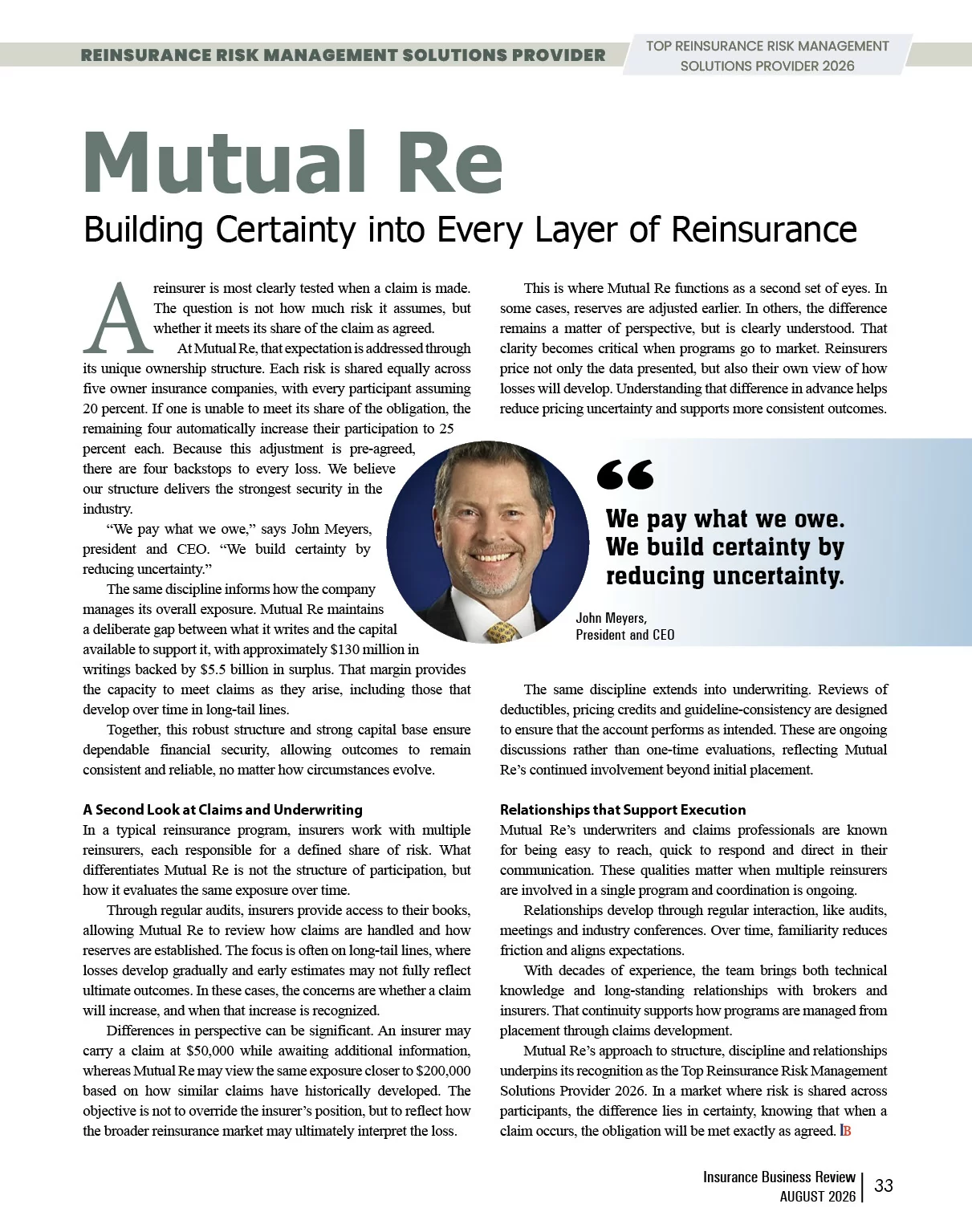
 John Meyers, President and CEO
A reinsurer is most clearly tested when a claim is made. The question is not how much risk it assumes, but whether it meets its share of the claim as agreed.
At Mutual Re, that expectation is addressed through its unique ownership structure. Each risk is shared equally across five owner insurance companies, with every participant assuming 20 percent. If one is unable to meet its share of the obligation, the remaining four automatically increase their participation to 25 percent each. Because this adjustment is pre-agreed, there are four backstops to every loss. We believe our structure delivers the strongest security in the industry.
“We pay what we owe,” says John Meyers, president and CEO. “We build certainty by reducing uncertainty.”
The same discipline informs how the company manages its overall exposure. Mutual Re maintains a deliberate gap between what it writes and the capital available to support it, with approximately $130 million in writings backed by $5.5 billion in surplus. That margin provides the capacity to meet claims as they arise, including those that develop over time in long-tail lines.
Together, this robust structure and strong capital base ensure dependable financial security, allowing outcomes to remain consistent and reliable, no matter how circumstances evolve.
A Second Look at Claims and Underwriting
In a typical reinsurance program, insurers work with multiple reinsurers, each responsible for a defined share of risk. What differentiates Mutual Re is not the structure of participation, but how it evaluates the same exposure over time.
Through regular audits, insurers provide access to their books, allowing Mutual Re to review how claims are handled and how reserves are established. The focus is often on long-tail lines, where losses develop gradually and early estimates may not fully reflect ultimate outcomes. In these cases, the concerns are whether a claim will increase, and when that increase is recognized.
Differences in perspective can be significant. An insurer may carry a claim at $50,000 while awaiting additional information, whereas Mutual Re may view the same exposure closer to $200,000 based on how similar claims have historically developed. The objective is not to override the insurer’s position, but to reflect how the broader reinsurance market may ultimately interpret the loss.
-
We pay what we owe. We build certainty by reducing uncertainty.
This is where Mutual Re functions as a second set of eyes. In some cases, reserves are adjusted earlier. In others, the difference remains a matter of perspective, but is clearly understood. That clarity becomes critical when programs go to market. Reinsurers price not only the data presented, but also their own view of how losses will develop. Understanding that difference in advance helps reduce pricing uncertainty and supports more consistent outcomes.
The same discipline extends into underwriting. Reviews of deductibles, pricing credits and guideline-consistency are designed to ensure that the account performs as intended. These are ongoing discussions rather than one-time evaluations, reflecting Mutual Re’s continued involvement beyond initial placement.
Relationships that Support Execution
Mutual Re’s underwriters and claims professionals are known for being easy to reach, quick to respond and direct in their communication. These qualities matter when multiple reinsurers are involved in a single program and coordination is ongoing.
Relationships develop through regular interaction, like audits, meetings and industry conferences. Over time, familiarity reduces friction and aligns expectations.
With decades of experience, the team brings both technical knowledge and long-standing relationships with brokers and insurers. That continuity supports how programs are managed from placement through claims development.
Mutual Re’s approach to structure, discipline and relationships underpins its recognition as the Top Reinsurance Risk Management Solutions Provider 2026. In a market where risk is shared across participants, the difference lies in certainty, knowing that when a claim occurs, the obligation will be met exactly as agreed.
Security, Discipline and Trust in Reinsurance Partnerships
Reinsurance risk management has moved beyond its traditional role as a capacity buffer to become a stabilizing force that shapes how insurers sustain balance sheet integrity amid persistent uncertainty. Social inflation, long-tail liabilities and volatile catastrophe exposure have altered how executives assess counterparties. The question is no longer how much risk can be transferred, but how reliably it can be recovered when claims materialize over years or even decades.
Confidence in a reinsurer’s ability to pay remains the anchor of every engagement. Insurers operate on the front line, settling claims in real time while relying on recoveries that may arrive later. The gap between those two moments defines financial strain or stability. A reinsurer that demonstrates sustained capital strength, disciplined underwriting exposure and long-term continuity provides more than coverage; it reinforces the insurer’s own promise to policyholders. Longevity, surplus positioning and structural alignment between risk assumed and capital held have become quiet signals that inform decision-making at the executive level.
The relationship also evolves through transparency in how risk is interpreted. Loss development rarely follows neat timelines, especially in casualty lines where claims mature slowly. Independent perspectives on reserves can influence how insurers present their portfolios to the market, affecting pricing outcomes and capital allocation. A reinsurer that actively reviews claims development and challenges reserve adequacy introduces a feedback loop that sharpens internal judgment. That influence extends to underwriting behavior, where guidance on pricing discipline, deductible structures and exposure selection can recalibrate portfolios over time without imposing rigid oversight.
Trust, however, is not built solely through analysis. Responsiveness and accessibility remain decisive in a market where timing often dictates outcomes. Brokers and insurers operate within interconnected networks where relationships carry weight alongside technical capability. Ease of communication, consistency in engagement and familiarity developed through repeated interactions shape how partnerships endure through cycles of stress and recovery. The value of a reinsurer becomes evident not only in moments of loss but in the day-to-day clarity it brings to decision-making. Cultural alignment, predictability in communication and clarity in expectations further reinforce the stability insurers seek when entering long-term arrangements.
Mutual Re reflects this model through a structure centered on financial security and shared accountability. It operates with a surplus base that significantly exceeds its underwriting volume, reinforcing confidence in its ability to meet obligations across varied claim horizons. Its ownership framework distributes risk across multiple stakeholders who assume greater responsibility if one participant fails, creating an embedded safeguard that strengthens continuity. The firm complements this foundation with ongoing reviews of underwriting and claims practices, offering insurers an external perspective that informs reserve setting and portfolio adjustments.
Its emphasis on prompt claims settlement and direct engagement through experienced underwriting and claims teams supports the relationship-driven nature of the reinsurance market. For executives evaluating reinsurance partners, Mutual Re presents a disciplined approach grounded in capital strength, accountability and consistent interaction. Its long-standing presence in the market, combined with a focus on incremental improvement, signals an organization that prioritizes continuity while adapting to evolving risk conditions. Continued engagement across underwriting, claims and broker relationships ensures that its role extends beyond coverage into sustained partnership value over time.
...Read more
Reinsurance Risk Management Solution Providers Info
Q1
What Do Reinsurance Risk Management Solutions Providers Do?
Reinsurance Risk Management Solutions Providers help insurance companies manage financial exposure by transferring risk, strengthening capital management and supporting underwriting stability. Their services often include treaty and facultative reinsurance, catastrophe protection, portfolio analysis, risk diversification and advisory support. Together, these capabilities help insurers deal with the changing market conditions while maintaining long-term underwriting capacity.
Q2
How Does Mutual Re Differentiate Itself Among Reinsurance Risk Management Solutions Providers?
Mutual Re stands out among Reinsurance Risk Management Solutions Providers through its long-established reinsurance underwriting association model. Founded in 1921, it primarily serves small- to mid-sized mutual insurance companies through the broker market and provides access to more than $6 billion in available capital backed by five assuming companies. Its collaborative structure helps diversify risk while supporting long-term financial stability for participating members.
Q3
What Should Insurers Look for When Choosing Reinsurance Risk Management Solutions Providers?
When evaluating Reinsurance Risk Management Solutions Providers, insurers should consider financial strength, underwriting expertise, risk diversification, capital support and responsiveness. The ability to build long-term relationships is equally important, especially as risk profiles change over time. Providers that combine disciplined underwriting with flexible reinsurance structures can help insurers maintain stronger portfolio stability.
Q4
Why Is Risk Diversification Important in Reinsurance Management?
Risk diversification is at the core of Reinsurance Risk Management Solutions Providers because it helps reduce exposure to concentrated losses across an insurance portfolio. Diversifying risk among multiple participants strengthens financial resilience and supports more consistent underwriting. That approach also helps insurers remain better prepared when catastrophic events or unexpected losses occur.
Q5
How Does Mutual Re Support Long-Term Risk Management for Insurance Companies?
Mutual Re supports insurance companies through Reinsurance Risk Management Solutions Providers services that emphasize collaborative risk sharing and dependable capacity. Its underwriting association brings together five assuming companies under a joint liability structure, giving participating insurers access to significant capital resources while drawing on decades of experience serving the mutual insurance market.
Q6
How Are Reinsurance Risk Management Solutions Providers Evolving?
Today's Reinsurance Risk Management Solutions Providers are expanding their capabilities with advanced analytics, catastrophe modeling, portfolio optimization and strategic capital management. These tools help insurers understand changing risk exposures, respond to evolving regulatory expectations and make more informed underwriting decisions while strengthening long-term financial resilience.
